
Solar panels, battery storage & EV charging explained
solar pv
solar panels explained
A PV (or Photo Voltaic) system captures the sun's energy and converts it into electricity that you can use in your home, to charge an electric vehicle. . . or store in batteries for later use.
A typical system consists of three primary components: SOLAR PANELS to absorb and convert daylight into electricity, a solar INVERTER to convert the panels' output to Alternating Current (AC) and BATTERIES to store excess energy.
An increasing common addition to Solar PV Systems are EV VEHICLE CHARGERS.
If you have any questions, or to discover the various finance options that are available, call our engineers free for a chat!
freephone: 08000 30 27 77

pv panels
solar panel installations
Solar panel arrays will be designed and specified in your FREE ENERGY REPORT, to give you the optimum kWh output per square meter. . . blue skies not required!
The type of panels fitted will be dictated by; the area available, the safe load bearing capability of your roof, the desired kWh output and, of course, your budget.
Panels are 1m wide, with lengths ranging from 1.6m (weighing 18kg ) to 1.9m (weighing 21.6kg ), with power outputs from 250w to 400w.
CLICK FOR SOLAR PANEL FAQsDo solar panels work in the UK climate? Very much so! Solar panels generate electricity from daylight, not direct sunshine (blue skies not required! ), so they still perform well on cloudy days. Of course, you'll generate more in summer than in winter due to the difference in day length, but the annual output is sufficient enough to deliver meaningful savings, anywhere in the UK.
Does my roof need to be south-facing? South facing roofs give the highest annual yield, but systems orientated to the East or West work well too. Although their peak output may be around 15 to 20% lower, this enegy generation is spread more evenly throughout the day.
Can PV panels be mounted on a garage or outbuilding? Yes, panels can be installed on an outbuilding, but it's important to make sure that the roof is strong enough, and the structure needs its own electricity supply (which Solŵr engineers can also install! ).
Do solar panels need cleaning? In the UK, rain will effectively clean your roof mounted panels, so long as they have an incline of 15 degrees or more. Debris, such as dead leaves, is more likely to build up on ground-mounted panels (which are easy to reach! ). If you live in a very dusty location, such as alongside a major road, your panels may need to be cleaned occasionally.
How much maintenance does a solar PV system require? You don’t need to do much at all to keep your solar panel system running well. You'll find details of any maintenance checks that you should make to ensure everything is working properly in your welcome pack.
How long do solar panels last? Your solar panels should last 25 years or more, but your solar inverter will need to be replaced after around 12 years.
Is the system covered by warrantee? Most inverters have warranties of at least five years, which can often be extended up to 15 years. You may find that a 15-year warranty costs almost as much as a brand new replacement inverter, so consider the option carefully.
Do I need a smart meter? Although a smart meter is not required to install solar panels, you’ll need one if you want to take advantage of your energy supplier's SEG rate.
Will solar panels add value to my home? Installing green tech, like solar PV, that increases your home's Energy Performance Certificate (EPC) rating. For example; simply improving your EPC rating from F to C can increase the value of your home by up to 15%!
How much solar can I install? In most cases, the size of an installation is limited by the number of panels that can fit on a roof which, for many houses, is less than 4kWp (4 kiloWatt Peak ).
How much power can I export? This limit is based on the inverter output, so you can typically export up to 4kW per phase (8 kW from a two phase domestic supply, or 12 kW for a three-phase connection ) to the grid without needing permission to connect.
How do I know if my panels are working properly? Every Solŵr installation includes an output meter that shows how much electrical power your solar panels are generating, and a reduction in this generation may indicate a fault.
Does a solar PV system require maintenance? Very little. PV panels have no moving parts, so the inverter is the only wearable component, typically lasting 10 to 15 years before replacement. Solŵr Wales recommend a visual check every couple of years, or a system health review if generation drops noticeably.
Can I install solar panels myself? Strictly, the answer is yes, so long as it is on your own property. . . but it's a false economy. Even assuming that you have the requisite skills, a DIY install would invalidate the equipment warrantees plus, the system could not be MCS certified, and without this certification, you would not qualify for SEG export income.
CLICK HERE TO CLOSE THESE FAQS
For information about the latest Perovskite, or Graphene Perovskite, solar panel technology, see; PEROVSKITE SOLAR PANELS
freephone: 08000 30 27 77
inverters
convert DC into usable AC
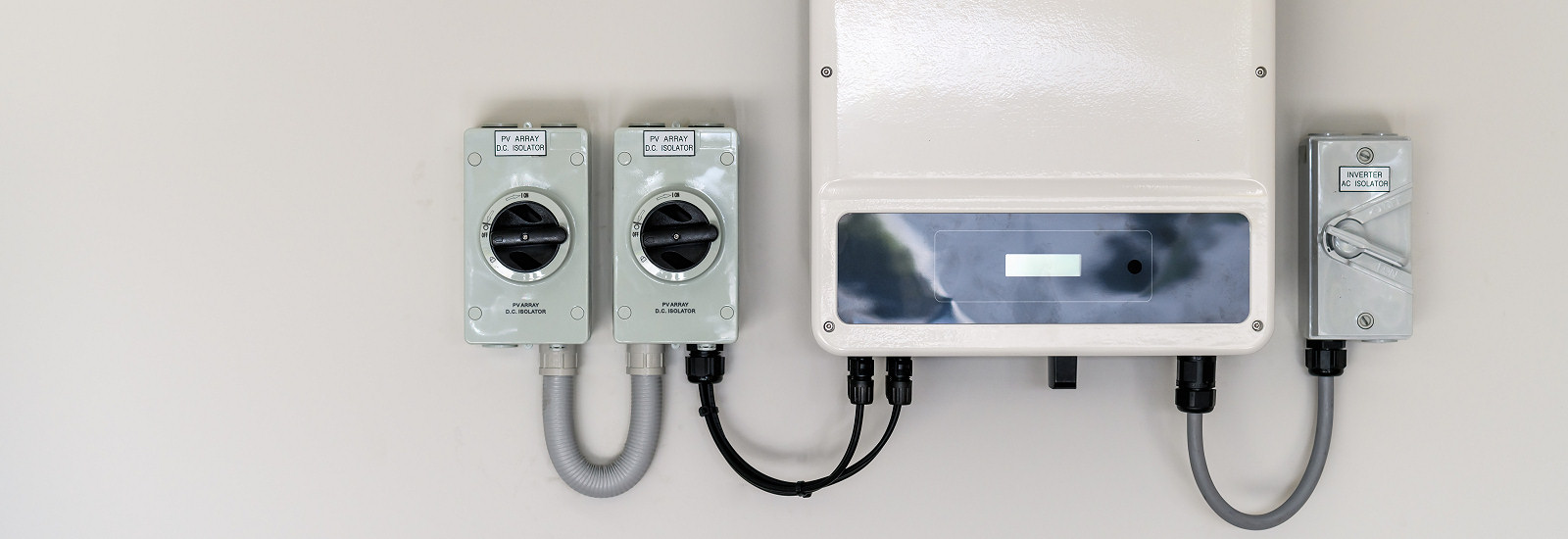
Solar Photo Voltaic panels generate electricity in Direct Current (DC ), which is required for battery storage (or EV vehicle charging ), but most of your existing home appliances and lighting need electrical power supplied in Alternating Current (AC ).
The job of an 'Inverter' is simply to convert the Direct Current coming from the panels, or your batteries, into useable AC.
Inverters are rated according to their conversion capacity, measured in Kilowatt Hours. . . so the greater your system's generating capability, the higher the rating of Inverter you will need.
freephone: 08000 30 27 77

batteries
storing excess solar energy
Any electrical power that your solar panels generate, but is not used immediately (or exported to the grid ), can be stored in batteries. . . providing power after dark, when solar panels are not producing.
CLICK FOR BATTERY STORAGE FAQsIs battery storage essential? Although a battery is not required for your solar array to function, adding one is highly recommended. Solar panels generate most electricity during the day, when you might not be home, so it makes sense to store this excess energy for use in the evening, maximising your return on investment.
How long should I expect batteries to last? Most Li-on home batteries come with a manufacturer's 10-year warranty or around 6,000 cycles. . . but you can still expect to retain 70% to 80% of the original rating, well beyond their warranty term.
What capacity of battery will I need? It depends upon how much electricity your household uses, but a battery with a capacity of between 5 and 15 kWhs will adequately serve most domestic users. (As a guide, a 10 kWh battery will typically cover the average UK household's evening use of around 8 hours, although the use of high drain appliances such as electric ovens, immersion heaters, or EV charging will shorten the output time. )
Is solar worth installing without batteries? Yes. . . solar-only has the lowest upfront cost and, therefore, represents the fastest return on investment. The trade-off for this saving is, of course, poorer evening cover.
Can batteries be added to my system later? Yes, so long as your current inverter is compatible. Most Solŵr retrofits involve installing a new battery alongside the existing inverter. . . fitted in one day, with minimal disruption and requiring no roof access. We regularly fit batteries to existing solar systems, including those that Solŵr didn't originally supply or install!
What happens in the event of a power cut? For engineer safety, most battery systems will disconnect from the grid during a power cut, and remain offline until power returns. However, ask our engineers about the Tesla Powerwall, which is able to switch the whole home to battery power during an outage!
CLICK HERE TO CLOSE THESE FAQS
Whilst not an essential part of a solar PV system, your FREE ENERGY REPORT will include details of the batteries that are most compatible with your proposed system's output, and a guide to the finance packages available.
freephone: 08000 30 27 77
Solŵr Wales ONLY install Lithium ion (Li-ion) batteries for solar energy storage. Unlike 'lead acid' batteries, Li-ion are effectively maintenance free and have a higher 'cycle rate', which means that they can be charged and discharged many more times without losing their storage capacity.

ev charging
power your vehicle at home
Although an electric vehicle (EV) can be charged from a standard household 3-pin plug socket, domestic supply is not designed for the loads that EVs require. . . which can cause overheating.
All EV chargers supplied by Solŵr Wales are installed on dedicated circuits, specifically designed to handle increased car charging loads. Each unit offers fast charging (at 7kW), with type 2 connectors compatible with most plug-in EVs, are protected against the elements and App-controlled.
HOME ELECTRIC VEHICLE CHARGING FAQsAre grants available for home charger installs? Yes! Through the UK Government's Electric Vehicle Homecharge Scheme (EVHS) you may receive up to 75% of the cost to purchase and install a home charging pod (capped at £350 ).
Is my domestic supply suitable? Many West Wales homes with a 60 Amp or higher mains supply can install a 7 kW charger without upgrades. If your existing consumer unit or supply is undersized, our engineers will advise on mains uprating or additional protection devices to accommodate your new EV charging point.
Can home charging pods be remotely controlled? 'Smart' EV chargers offer Wi-Fi or Bluetooth connectivity, load-management features, scheduled charging and automatic tariff integration. This means you can optimise charging during off-peak electricity rates, whilst monitoring consumption from your smartphone.
Where should my charger be located? Ideal situations include your driveway, garage wall, or car port, with easy cable reach to your parking spot. When positioning your charging pod we consider weather protection, Wi-Fi signal strength and cable length.
What if I have no off-steet parking? For safety and security, cables connecting your vehicle to the charging pod must remain within the boundaries of your own property.
How quickly will my car charge? Charging time depends on your EV's onboard charger rate and, of course, your charger's output. A typical 7 kW home charger delivers around 25 miles of range per hour, so a full charge on a 200-mile battery would take around 7 to 8 hours (ideal for overnight charging ).
What maintenance is required? Routine maintenance is minimal, you just need to keep the charger clean, check the cable's integrity from time to time and, if you have a smart charger, update its firmware when prompted. Annual safety inspections ensure that your EV charger remains fully compliant with BS 7671 regulations.
Can Solŵr install commercial chargers? Yes. Commercial installations can include multiple Type 2 or rapid chargers with integrated payment applications, and load management to prevent overload. Our engineers will handle site surveys, DNO notifications, and quote for any civils required for business EV charging solutions.
CLICK TO CLOSE THESE ANSWERS
The majority of EV charging at home takes place overnight, when demand for energy from the grid is at its lowest (and cheapest ), but using solar panels to charge your EV during the day adds an extra layer of motoring convenience.
Note: Most domestic properties have single phase power, which limits the maximum charging rate for EVs to 7kW. Faster chargepoints (such as 22kW units) are usually only suitable for commercial properties with a three phase power supply.
freephone: 08000 30 27 77

installing
solar panels & battery storage
Installations are meticulously planned and can usually be completed in two days, depending upon site access, the scaffolding required, and work necessary to integrate the system.
Solŵr Wales operate a non-invasive, clean site policy. In fact, you won't even know our engineers are there until the time comes to locate the Inverter indoors. . . and batteries if you've chosen to add storage. Call our engineers for their advice, and information about the finance options available to you!
freephone: 08000 30 27 77
Whilst roof mounted panels are the most common, they are by no means the only option. If you have outside space that is not subject to excessive shading, you may wish to consider a ground mounted array.
CLICK FOR SOLAR INSTALLATION FAQsDo I need planning permission? Falling under 'Permitted Development Rights', domestic solar installations do not usually require planning permission, provided they fall within specific size limits and are not on a listed building, or in a conservation area.
What is the 33% rule? Unlike the US, the UK has no national building codes restricting panels to a maximum of 33% of a roof's surface area. In the UK, this rule refers instead to the installation of an inverter that is up to a third larger than the system's AC capacity. 'Oversizing' in this way captures more energy on cloudy days, while keeping the inverter running efficiently during peak-sunlight hours.
Can panels be mounted on a real slate roof? Yes! To prevent damage, an installation on slate roofs uses hooked brackets that lift individual slates, rather than drilling through them.
How long does installation take? Most domestic installs finish within around two days on site, from scaffold erection, to system activation and final clean-up. Larger systems or complex roof layouts can take longer, but this will be stipulated in your quotation.
Is scaffolding always needed? Scaffolding is a safety requirement for pitched roof installs, usually erected 1 to 2 days before the panels go up, then removed shortly after the work is finished. Sometimes, for single-storey or low-eaved properties, a mobile tower system can be utilised instead.
CLICK HERE TO CLOSE THESE FAQS
Although slightly more costly to construct initially, ground mounted panels can be more accurately aligned to optimise their efficiency, and are more easily accessible for cleaning.
BONUS: Where can Solŵr Wales install solar panels?Solŵr Wales are happy to install solar panels, inverters & batteries anywhere in Pembrokeshire, West Carmarthenshire and South Ceredigion, including; Broad Haven, Little Haven, Marloes, Dale, Goodwick, Pendine, Crymych, St David's, Cardigan, Pembroke, Pembroke Dock, Solva, Saundersfoot, Freshwater East, Lamphey, Tenby, Newgale, St Brides, St Ishmaels, Talbenny, Roach, Fishguard, Narberth, Burton, Hook, Llangwm, Letterston, Langharne, Porthgain, Whitland, Maenclochog, Newport, St Clears, Haverfordwest, Milford Haven, Manorbier, Simpson Cross, Neyland and Letterston.
CLICK OR TAP HERE TO CLOSE THIS INFO
SOLŴR : SURVEYS : ASHP : UPGRADING : COMMERCIAL PV : GRANTS : SEG
Solŵr Wales. The Old School, Station Road, NARBERTH, Pembrokeshire SA67 7DU
Reg. Office, Policies, VAT & Accreditations